3 min read


Beely, a pioneer in car subscriptions, wanted to move beyond technical AI experiments and build a solution that delivers measurable business growth. Through a long-term and ongoing partnership with Columbia Road, Beely has transformed its digital experience by implementing a sophisticated multi-agent AI system.
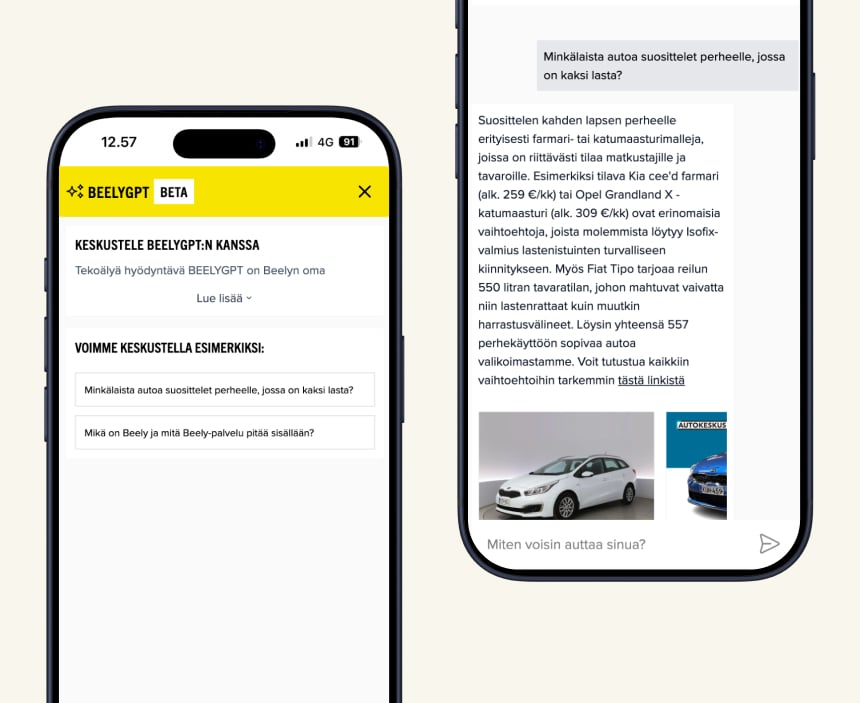
This transition from a data architecture project to a fully fledged AI transformation automated internal content creation and introduced "BeelyGPT" to guide customers through complex purchase decisions. The result is a scalable "golden data asset" that serves as the backbone for Beely's future customer service and sales operations.
The starting point: Defining a business-driven need for AI
Beely's initial goal was clear: increase the conversion rate from car product pages to completed purchases. While many companies treat AI as a technical gimmick, Beely saw it as a tool for fundamental business scalability. They identified a need to support customers during the high-consideration phase of buying or subscribing to a car, while simultaneously making their internal sales and service processes more efficient.
The project began as a data architecture initiative. However, through collaborative workshops and organic discussions, the focus shifted toward practical AI applications. We started with a small, manageable proof of concept: generating unique car descriptions. When this proved successful and time-efficient, the ambition grew. Beely decided to place a customer-facing AI agent prominently on their website, a move that signalled their confidence in using AI to solve real customer problems rather than just providing a novelty feature.
Our approach: Architecting a multi-agent AI system for accuracy
Instead of building a single, monolithic chatbot, we developed a modular multi-agent model. A single agent often struggles to ground its answers correctly when faced with a vast knowledge base. To solve this, we created an orchestrator agent that acts as a router. When a customer asks a question, the orchestrator identifies the specific intent and passes the task to specialised sub-agents.
These sub-agents are connected to a managed Retrieval-Augmented Generation (RAG) system using Google File Search. This allows the system to crawl through articles, inventory data, and CRM records in real time. This structure prevents "context pollution" and ensures that each agent focuses on a narrow, well-defined task.
To ensure reliability, we implemented several technical safeguards:
- Confidence scoring: Every response is assigned a score from 0 to 1. If an answer falls below the 0.7 threshold, the system identifies the need for human intervention rather than risking an incorrect response.
- Automated monitoring: A separate "evaluation agent" monitors the customer-facing agent's logs, identifying gaps in the knowledge base and summarising reasoning issues at scale.
- PII redaction: Strict scoping and redaction mechanisms ensure that no personally identifiable information is sent to the Large Language Model, maintaining high data security standards.
The collaboration has been iterative and highly agile. We have worked in weekly sprints with Beely's team, testing the system live and adjusting the logic in response to ongoing feedback.
Impact: Securing tangible ROI in a hyped landscape
The partnership has moved AI from a roadmap item to a core part of Beely's daily operations. The most immediate win was automating car descriptions, which has freed up significant time for the internal team to focus on higher-value tasks.
The soft launch of BeelyGPT has already shown that the system can handle the vast majority of customer queries effectively. This has fundamentally changed the customer service model. A customer who would have traditionally waited for a human agent to answer a question about, for example, a specific car or contract can now get an accurate, grounded response instantly. Internal teams have found the tool so efficient that they have even started to use BeelyGPT themselves to find information faster, effectively scaling their expertise across the organisation.
Highlights: Lessons from scaling agentic workflows
The most significant challenge during the collaboration has been context management. Initially, the system struggled to interpret the "why" behind user questions. We learned that the trickiest part of building a successful AI agent is not the LLM itself, but the grounding and guidance logic that ensures the response is relevant to the user’s specific situation.
Our approach treated AI as a core engineering discipline instead of a series of isolated experiments. We followed a structured roadmap that prioritised stability, beginning with automating background processes before scaling to more complex, customer-facing logic. This methodical framework removed the unpredictability typical of early AI adoption. It provided Beely's leadership with the confidence to maintain a flexible project scope while staying focused on tangible business outcomes.

The way forward: Evolving our partnership through continuous innovation
Beely now possesses a "golden AI asset" that is ready to be scaled across the entire organisation. The next phase involves an official, large-scale launch and the integration of AI agents with additional channels, including lead generation and automated email responses.
This project has shifted Beely's overall digital strategy. They are no longer just exploring AI; they have built the internal capability to implement it across their business. Beely has even recruited dedicated internal talent to work alongside our team, ensuring that AI remains a permanent driver of their business renewal and growth.