29 Jan, 2026
'/%3E%3Cdefs%3E%3ClinearGradient id='a' x1='0' y1='-5' x2='11' y2='-5' gradientUnits='userSpaceOnUse'%3E%3Cstop stop-color='%2300F'/%3E%3Cstop offset='.339' stop-color='%23A0A'/%3E%3Cstop offset='.677' stop-color='red'/%3E%3Cstop offset='1' stop-color='%23FA0'/%3E%3C/linearGradient%3E%3C/defs%3E%3C/svg%3E)
6 min read



AI agents are starting to change how digital commerce works. New protocols, partnerships, and use cases are appearing fast, raising fresh questions for both consumers and merchants. But what does agentic commerce actually mean in practice, and where could it realistically make a difference?
This blog takes a practical look at agentic commerce from two angles: how everyday shopping journeys may change, and what merchants may need to consider as these technologies develop. The goal isn’t to predict the future, but to explore what's beginning to take shape and why it matters.
Part 1: The customer perspective - how AI agents support, guide, and automate shopping
Scenario 1: AI as an assistant – Product discovery and early recommendation
AI has already become a trusted assistant for many of us. Using tools like ChatGPT or Gemini to research products is increasingly common. McKinsey reports that half of all consumers now use AI when searching online, highlighting how deeply this behaviour is already embedded.
Take a real example: searching for running shoes that look stylish enough to pair with everyday clothing but remain functional for actual running. A natural-language query, such as asking for black or neutral shoes available in Finnish stores, allows an AI assistant to review large product ranges and recommend suitable options.
However, this is not yet agentic commerce. While AI helps surface relevant products, the customer still performs the final steps: going to the shop, trying items on, and making the purchase. This stage forms the technical foundation for what comes next.
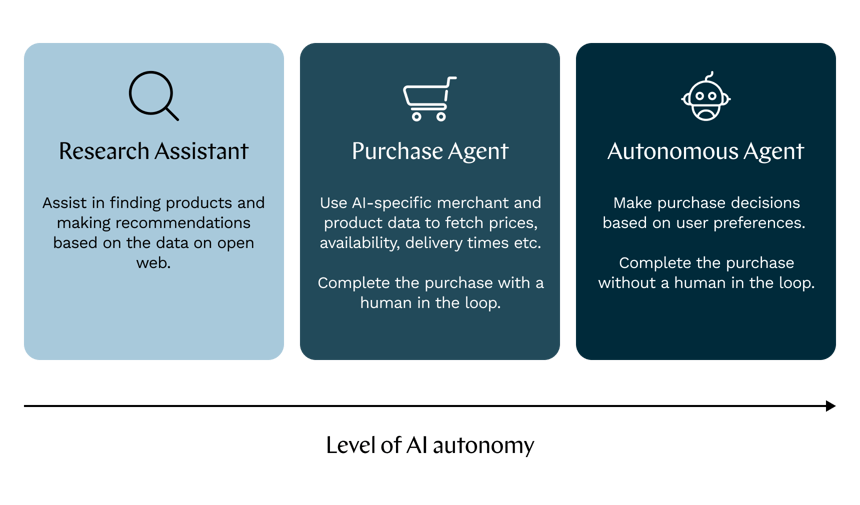
Scenario 2: AI agents with a human in the loop – Assisted purchasing
The next evolution is for AI not only to recommend products but also to support the transaction itself.
This part has evolved a lot in recent months. First, OpenAI's Agentic Commerce Protocol (ACP) with Instant Checkout was introduced and piloted with Etsy, and later included in, for example, the Shopify Winter '26 release.
Just recently, Google introduced the Universal Commerce Protocol (UCP) and will bring it to its search and Gemini apps. Shopify released an Agentic Plan as an intermediate layer between the ecommerce platform (Shopify is not mandatory) and AI interfaces like Gemini, ChatGPT, and Copilot to help bring AI-assisted purchasing to the wider public.
A typical assisted purchase flow might look like this:
- Customer: I'm looking for a handmade silver bracelet for around $100. It should be gift‑wrapped and delivered within two days.
- AI agent: Presents a curated set of product cards, explaining why each option matches the criteria.
- Customer: Selects an item, chooses a size, and completes the Instant Checkout.
- AI agent: Confirms the order.
The experience resembles a traditional ecommerce journey, but with a conversational interface replacing search bars, menus, and filters. The customer still approves the purchase, but AI streamlines the discovery and checkout process.
Scenario 3: Autonomous AI agents – When purchases happen automatically
Looking ahead, AI agents will increasingly make decisions and complete purchases entirely on the customer's behalf. This is where agentic commerce becomes transformative.
Consider a family shopping list app: when someone adds "milk", an AI agent could immediately compare prices and availability across local shops, selecting the best option and arranging delivery, without the customer having to manually complete checkout.
Now layer in smart‑home automation: when a fridge notices milk running low, it notifies the agent directly. No human interaction needed.
For fully autonomous purchases, the agent must understand:
- Product preferences (brands, sizes, price limits),
- Urgency levels,
- Acceptable substitutes
- Delivery constraints.
This model is especially beneficial for commodity purchases, such as detergent, toilet paper, or pantry staples, where convenience and price outweigh the emotional or experiential aspects of shopping.
Part 2: The merchant perspective – what businesses must prepare for
Scenario 1: Preparing product data for AI shopping assistants
In the running shoes example, notice how the query is phrased: in natural language rather than as structured attributes like weight or sole material. To stay visible in these journeys, merchants need to provide:
- Rich, descriptive product content, written in natural language,
- Data that explains benefits and characteristics rather than only technical specifications
- Content that AI models can interpret to determine suitability for a given customer query
AI already crawls websites for product information, and we can expect AI‑specific product feeds to become increasingly important as agentic commerce matures.
Scenario 2: Enabling single‑purchase agentic commerce
While AI tools are already capable of understanding product information and surfacing relevant options, actually completing a purchase introduces a new layer of complexity.
To support single‑purchase agentic commerce, merchants may need to ensure their ecommerce platforms can handle a few key capabilities:
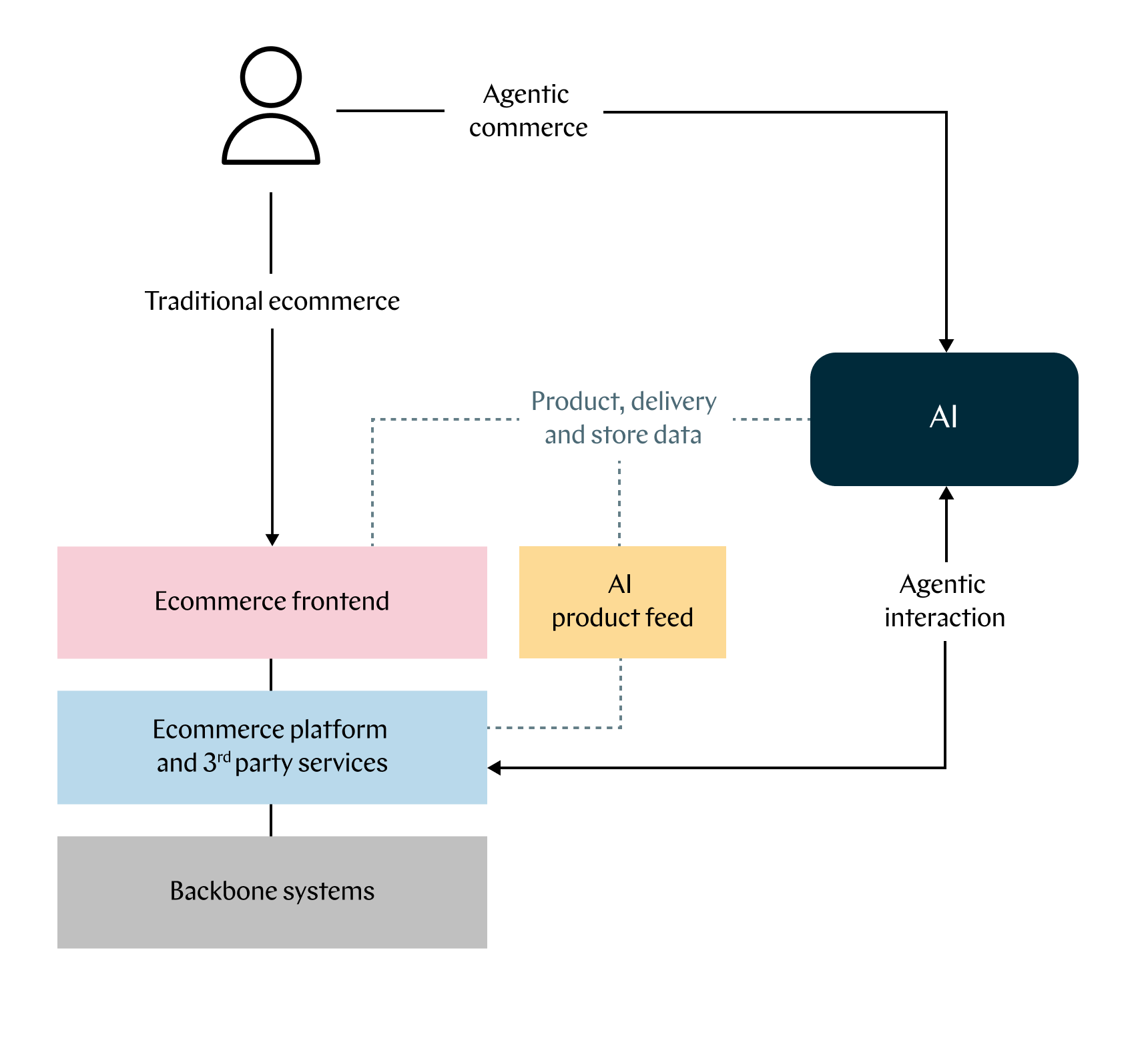
- Signal that the store supports agent‑led purchasing, for example, through AI‑specific or enriched product feeds.
- Offer a checkout flow that an AI agent can navigate, aligned with emerging technical standards.
One of the most visible standards today is the Agentic Commerce Protocol (ACP), proposed by OpenAI. While still evolving, ACP provides an early indication of the kind of requirements merchants may need to meet. At a high level, welcoming AI agents means exposing structured product information such as:
- Product availability
- Pricing
- Purchase eligibility
- Store‑level metadata
Together, these signals help an agent understand what can be bought as well as whether and how a purchase can be completed on behalf of a customer.
Agentic checkout and payments
To make agents work in practice, ecommerce systems need to expose a set of technical endpoints that allow an agent to move through the buying process. This could include the ability to:
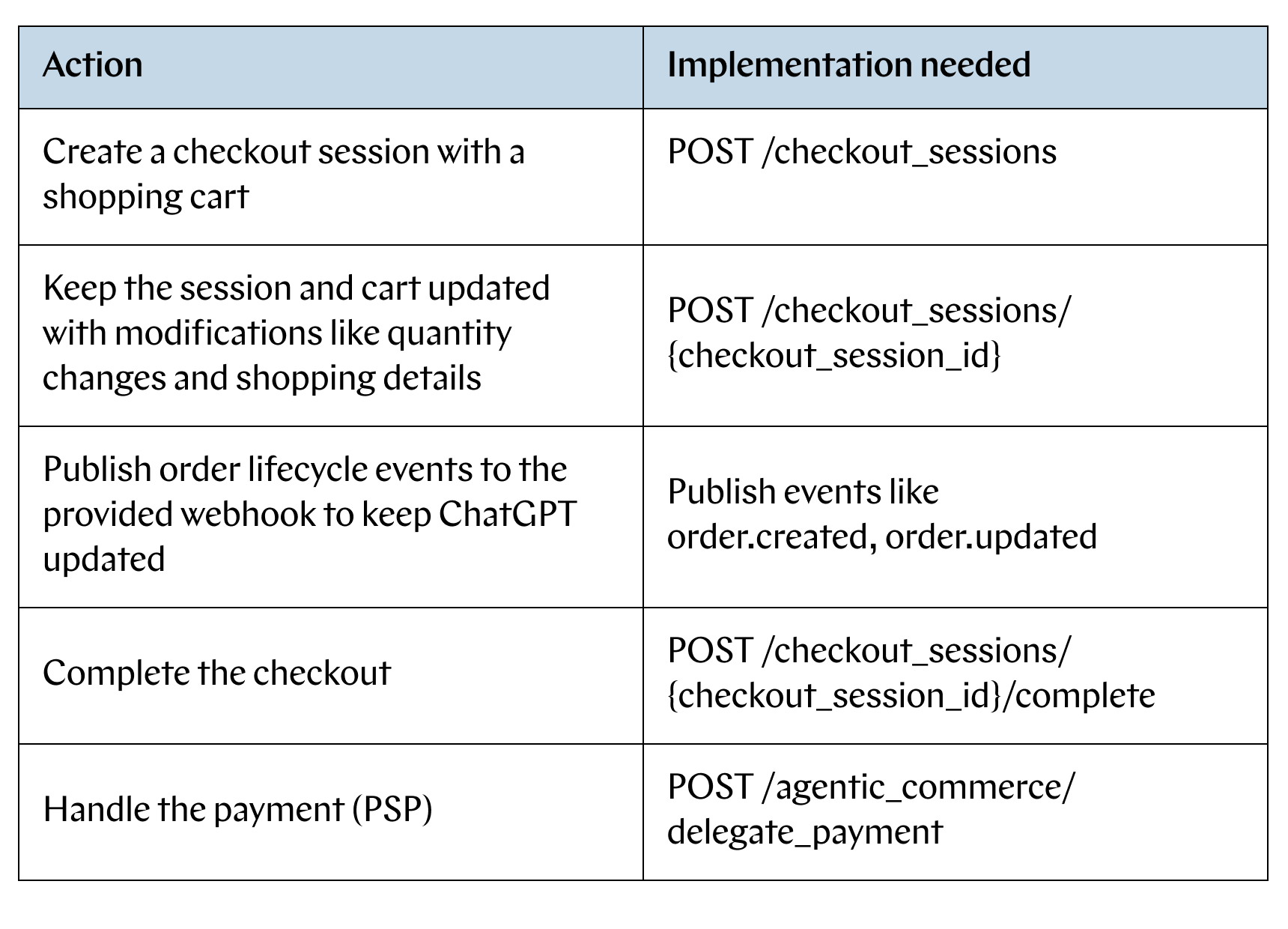
Today, only a small number of payment providers support this kind of flow. Stripe is one of the most visible examples, though it is reasonable to expect others to follow as standards mature.
From a merchant’s perspective, ACP can look similar to integrating a new sales channel or marketplace. Orders still flow into existing systems, confirmations go out as usual, and product data needs to remain accurate and consistent.
For businesses using major ecommerce platforms, some of this functionality may be abstracted away over time. Initiatives such as Shopify’s Agentic Storefronts or Commercetools’ AI Hub point in that direction. Custom-built platforms, however, are more likely to need hands-on effort to adopt and maintain agentic commerce capabilities.
Scenario 3: Enabling autonomous AI purchasing – Preparing for full automation
In fully autonomous scenarios, product data becomes even more business‑critical. For commodity purchases in particular, AI agents depend on clean, highly structured information, including:
- Availability and stock status
- Pricing, discounts, and promotions
- Package sizes and units
- Brand, model, and variant details.
To enable this, merchants need to ensure AI agents can reliably:
- Add products to a basket
- Complete purchases without unnecessary friction
- Move through checkout flows that are free from disruptive upsell pop‑ups, mandatory account creation, or forced marketing subscriptions.
As privacy protections tighten, merchants should also expect to receive less granular analytics from agent‑driven sessions than from traditional, browser‑based shoppers.
Are merchants prepared for the shift to agentic commerce?
Rather than a single switch to flip, preparedness for agentic commerce is likely to be incremental. For many organisations, the first step is not adoption, but assessment. Businesses may want to start by asking practical questions such as:
- Do our products surface in AI-driven recommendations today, and if so, how?
- Are our product descriptions written in language customers themselves would naturally use?
- Is our ecommerce stack flexible enough to support new interaction patterns, such as conversational journeys or agent-led checkouts?
While some platforms are beginning to introduce features that support agentic commerce, more complex or highly customised setups are likely to require hands-on development work.
This makes having a clear roadmap particularly important. Which changes could deliver quick wins with minimal disruption? And which require longer-term, strategic investment?
Agentic commerce may not yet be fully mainstream, but early signals suggest it is beginning to emerge in practical, testable ways. Merchants that start exploring these questions now will be better positioned to respond as the space continues to evolve.
Final thoughts: how shopping behaviours will evolve
Not all purchases will embrace AI at the same pace. How quickly agentic commerce takes hold will depend largely on what people are buying and how involved they want to be in the decision.
When people want control
Fashion items, designer furniture, vinyl records, gourmet groceries.
These purchases are often more personal and experience-driven. For many shoppers, the act of choosing is part of the value itself. In these contexts, AI is more likely to support inspiration or discovery, rather than take over decision-making.
When people want assistance
Flights, transport, and mid-range considered purchases.
Here, AI may help by surfacing options, comparing prices, or suggesting optimal timing. Even so, many buyers are likely to want a final sense check, keeping humans in the approval loop.
When people prefer automation
Detergents, toiletries, and everyday household goods.
For routine, low-involvement purchases, convenience often takes priority over emotional attachment. This makes these categories strong candidates for higher levels of automation, where agent-led purchasing could play a larger role.
In B2B commerce, adoption is likely to be even faster. Repetitive buying cycles, predictable needs, and clear approval structures make autonomous agents a natural fit compared to B2C.
What is certain is that agentic commerce will become a major component of digital commerce in the coming years. Merchants who prepare early will gain a competitive advantage. Product feeds will need to move beyond rigid attributes towards natural-language descriptions. Ecommerce systems must support conversational checkouts. And brands will need to rethink how they appear and are selected within AI-driven channels.
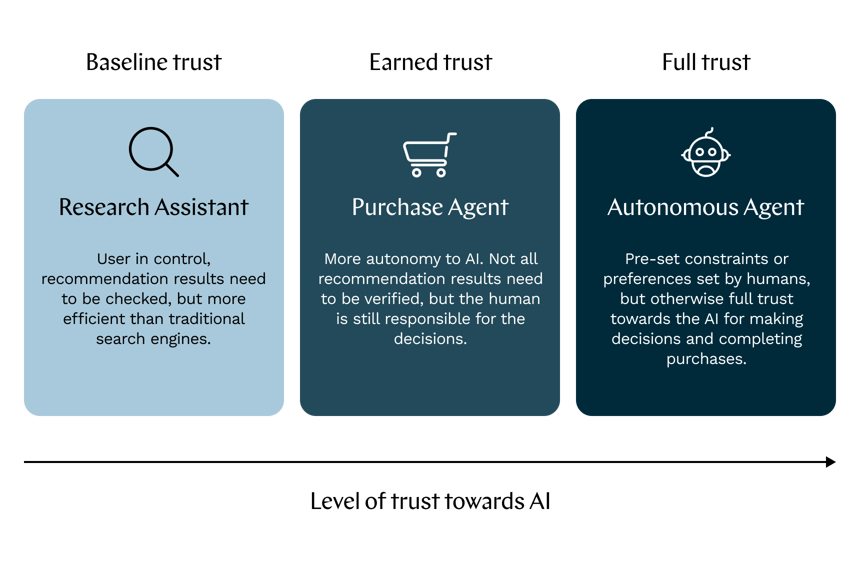
However, the speed of adoption will ultimately depend on trust. Customers will only hand over control if risks around incorrect purchases, security, and data usage are clearly addressed and transparently managed.
Ready to take the lead in agentic commerce?
If you want to understand how agentic commerce could work for your business or need help preparing your product data and ecommerce stack, our team is ready to help. Get in touch and let's explore your opportunities together.