24 Mar, 2026
'/%3E%3Cdefs%3E%3ClinearGradient id='a' x1='0' y1='-5' x2='11' y2='-5' gradientUnits='userSpaceOnUse'%3E%3Cstop stop-color='%2300F'/%3E%3Cstop offset='.339' stop-color='%23A0A'/%3E%3Cstop offset='.677' stop-color='red'/%3E%3Cstop offset='1' stop-color='%23FA0'/%3E%3C/linearGradient%3E%3C/defs%3E%3C/svg%3E)
3 min read



B2B buyers have stopped settling for clunky systems. They expect the same speed and ease at work that they get as consumers. This shift is turning the traditional sales model on its head.
An ecommerce site that only focuses on new leads is no longer enough. The real growth is found in how you serve your existing clients. Customer portals have become the "hot topic" for a reason: they are the bridge between manual overhead and scalable, digital-first growth. In this post, we explore why these portals are essential for modern self-service and how they transform both the customer journey and your internal efficiency.
Defining the portal: More than just ecommerce
Customer portal, dealer portal, partner portal... Digital self-service portals have many names. The commonality is that they provide a centralised location for customers to view and manage their company details, orders, and so on. The reason customer portals are a hot topic is that, when done right, they can greatly increase efficiency, create additional selling opportunities, improve data orientation, and deliver a better customer experience.
We often get asked why a customer portal is necessary if an ecommerce site is already running.
The two often use the same technology, but they have different goals. Standard ecommerce is an acquisition tool designed to turn prospects into customers. A customer portal is different. It's a hub for retention and efficiency where your existing clients manage their whole relationship with you. This includes things like contract pricing, historical invoices, and user permissions.
A good portal turns a series of separate transactions into a proper partnership.
The value exchange: Benefits for both sides
Portals work because of the efficiency they bring. By cutting down on manual tasks, businesses can do more with less effort.
For the customer: Autonomy and speed
-
24/7 availability: Buyers don't have to wait for your office to open to find an answer or place an order.
-
Simple reordering: Features like bulk uploads and saved lists make a long task much faster.
-
Clear data: Instant access to spend analytics and order history gives B2B buyers the transparency they expect.
For the seller: Operational excellence
-
Fewer errors: Moving away from phone calls and manual entry stops human errors in order processing.
-
Better use of talent: When routine tasks for smaller accounts are automated, your best salespeople can focus on being consultants for your biggest clients.
-
Better insights: Portals provide data that helps you see where customers get stuck. This makes it easier to decide what to build next.
The feature set: Building for utility
A successful portal reflects how your customer actually works. Depending on your industry, you might focus on documentation or fast reordering.
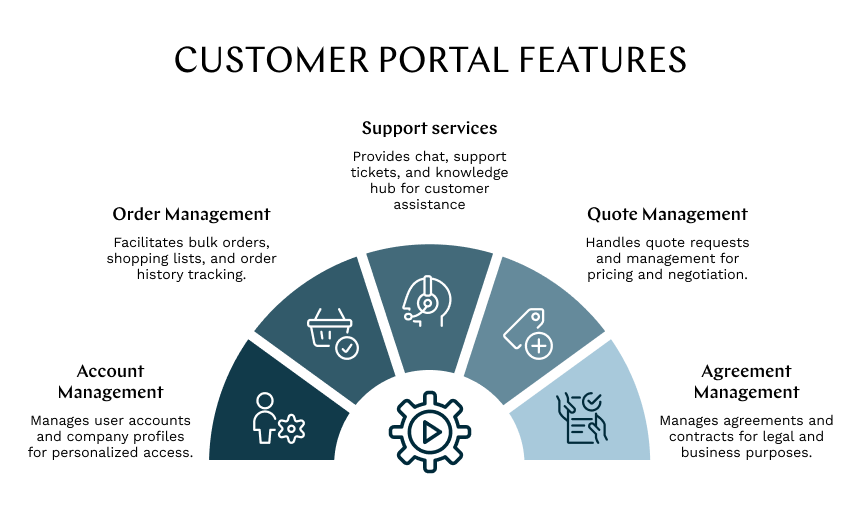
Common features include:
- Company and user management: Controlling who can buy and who can just view.
- Agreement tracking: Visibility into specific contracts and prices.
- Order tools: Bulk uploads, quotes, and one-click reordering.
- The knowledge hub: Easy access to manuals, CAD files, and support tickets.
It is worth noting that B2B buyers might often create orders away from their desks. The portal needs to work well on small screens and slow connections to be truly useful.
Implementation strategy: From vision to reality
Building a portal is a cultural change, not just a technical one. It's best to start small and focus on what brings value quickly.
1. Map the use cases
Talk to your stakeholders and customers. Find out where the manual work is happening and what causes the most frustration.
2. Technical architecture
Modern portals usually sit on top of other systems. They use APIs to pull data from ecommerce platforms, ERPs, and CRMs. This lets you build a flexible frontend using tools like Shopify, commercetools, or Salesforce.
3. Managing the change
Your sales and support teams might worry that self-service replaces them. It’s important to show them that the portal actually helps them. When they aren't stuck checking order statuses, they can spend more time on high-value work.
The future: agentic AI in the customer portal
The next step for portals is agentic AI. These aren't just chatbots. AI agents can be given specific goals and data to handle complex workflows.
For example, an AI agent could look at a customer’s usage and suggest a better agreement or a specific solution. Or, a chat interface could help troubleshoot technical problems by looking at a customer’s specific equipment. These systems will turn portals from simple storage into active business partners.
Scaling B2B operations: The ROI of a digital customer portal
Customer portals are no longer just an optional extra; they are a fundamental requirement for B2B companies aiming to scale without increasing headcount. By providing 24/7 self-service for routine tasks like invoice downloads, order tracking, and contract management, you significantly reduce the administrative burden on your support teams.
When implemented correctly, these portals lower churn by giving buyers the autonomy they prefer while freeing up your sales representatives to focus on high-value consulting. The result is a leaner, more data-driven operation that turns your existing ecommerce stack into a long-term engine for growth.
Ready to digitise your manual processes? Building a portal is a strategic move. Whether you’re looking at technology or deciding which features to build first, we can help you find the best path. Reach out to our team to talk about your B2B strategy or download our Digital Business Toolkit to start mapping your opportunities right away!